Cool Hearts and Quiet Rooms: What Laos Teaches Americans About the Power of Saying Less
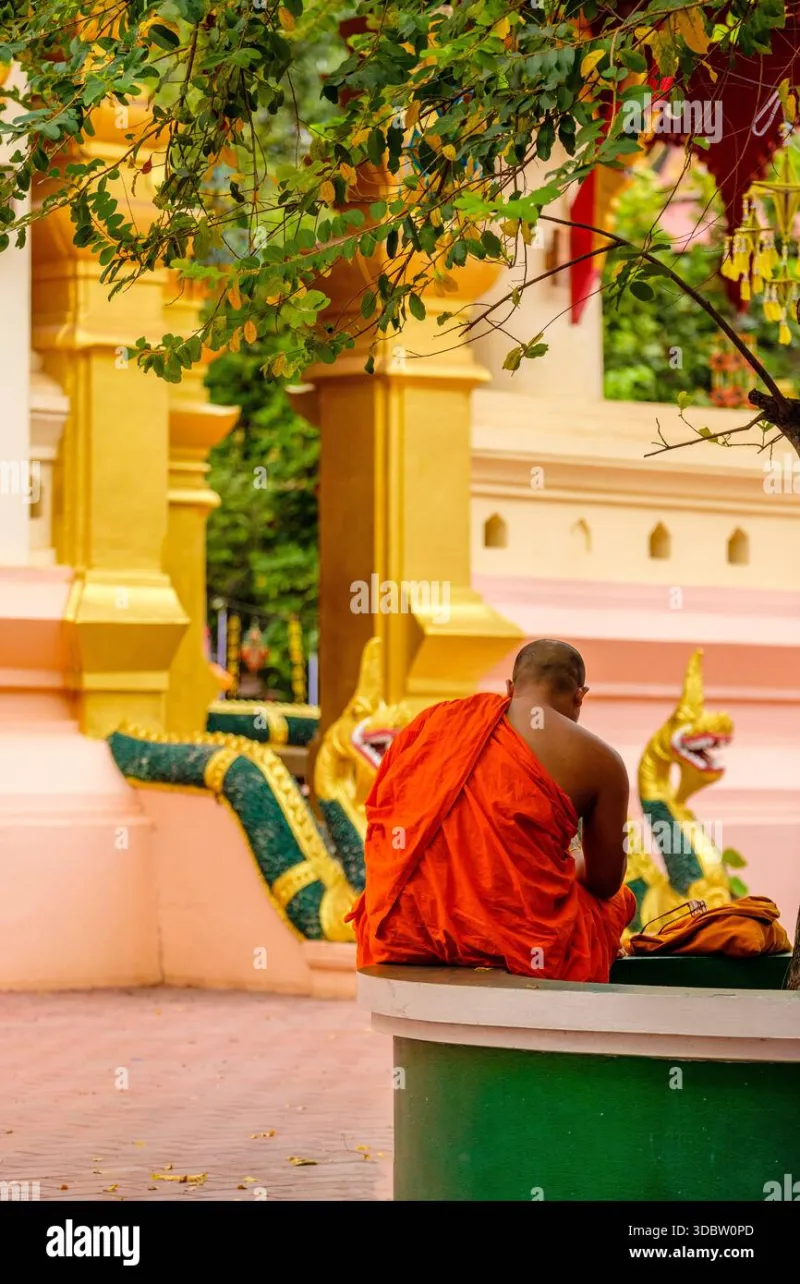
Photo: peaceful Laos temple monk silence meditation cultural, via c8.alamy.com
Most Americans land in Laos expecting the usual Southeast Asian sensory overload — chaotic markets, honking tuk-tuks, vendors calling out from every direction. What they find instead is something that takes a little longer to process: a country that moves quietly, speaks softly, and seems entirely unbothered by the silence sitting between words.
For travelers wired to fill every conversational gap, that silence can feel deeply uncomfortable at first. And then, somewhere around day three or four, something shifts.
What 'Jai Yen' Actually Means
The phrase jai yen — pronounced roughly like "jai yen" — translates literally as "cool heart," but the meaning runs a lot deeper than a simple idiom. In Laotian culture, keeping a cool heart means maintaining composure under pressure, avoiding public displays of frustration or anger, and approaching conflict with a kind of deliberate, almost practiced calm. It's the opposite of the American cultural instinct to express every feeling the moment it surfaces.
This isn't passivity. Locals aren't checked out or indifferent — they're simply operating from a different emotional framework, one that prizes inner steadiness over outward expression. Raising your voice, showing visible irritation, or pushing hard in a disagreement aren't just considered rude in Laos. They're seen as signs of personal weakness, a failure to manage your own interior world.
For visitors from a culture that tends to reward assertiveness and directness, this can be genuinely disorienting.
The Moment the Culture Shock Hits
Kayla, a 34-year-old marketing director from Denver, remembers the exact moment she felt it. She was at a guesthouse in Luang Prabang, trying to sort out a mix-up with her reservation. The woman at the front desk listened patiently, smiled gently, and offered a solution — all without any urgency, any apology, or any trace of the flustered energy Kayla had brought to the conversation.
"I kept waiting for her to match my energy," Kayla says. "And she just... didn't. She was completely unruffled. And I realized the problem wasn't the booking. The problem was me."
That kind of moment — equal parts humbling and clarifying — comes up again and again in conversations with Americans who've spent meaningful time in Laos. The country has a way of revealing your own communication habits with uncomfortable precision.
Marcus, a 41-year-old teacher from Atlanta who spent three weeks volunteering near Vang Vieng, describes a similar awakening. "Back home, I think fast and talk fast. It's just how things move. But in every interaction I had in Laos, there was this pause before people responded — not because they didn't understand me, but because they were actually thinking before they spoke. It made me realize I almost never do that."
The Philosophy Behind the Quiet
The roots of jai yen aren't just cultural — they're deeply spiritual. Laos is one of the most predominantly Theravada Buddhist countries in the world, and the influence of that tradition saturates everyday life in ways that go well beyond temple visits and morning alms ceremonies. The Buddhist emphasis on non-attachment, equanimity, and the cultivation of inner peace isn't reserved for monks. It's woven into how ordinary people navigate ordinary days.
In that context, emotional restraint isn't suppression — it's discipline. Choosing not to react impulsively is considered a form of wisdom, a daily practice as meaningful as meditation. When a Laotian person pauses before responding to you, they're not stalling. They're honoring the weight of the moment.
This also explains why laughter is so common and so genuine in Laos, even in difficult circumstances. The jai yen philosophy doesn't mean people don't feel things deeply. It means they've learned to hold those feelings without being controlled by them.
When the Silence Becomes a Gift
One of the more unexpected discoveries American travelers report is how much richer conversations become once they stop rushing them. Without the pressure to fill every pause, interactions slow down enough to actually land.
Sarah, a 29-year-old from Portland who spent a month traveling solo through southern Laos, found that her most memorable conversations happened precisely because she stopped trying to steer them. "I started just sitting with people — at markets, at temples, on slow boats — and letting things unfold. I didn't always have the words, and neither did they. But something was still being communicated. It was like learning a different language that didn't involve talking at all."
That experience — of connection without constant verbal output — is something many visitors carry home with them, sometimes without fully understanding it until they're back in their regular lives.
What It Looks Like When You Bring It Home
The practical takeaways from an encounter with jai yen aren't always easy to translate back to American life. You can't exactly pause for thirty seconds before responding in a fast-moving work meeting or ask your family to lower the conversational temperature at Thanksgiving. But the underlying shift in awareness tends to stick in subtler ways.
Many travelers describe becoming more conscious of when they're speaking to fill space versus speaking because they actually have something to say. Others notice they've become better listeners — not in the performative, nodding-while-waiting-to-talk way, but genuinely present to what the other person is expressing. A few describe something harder to name: a lower baseline of reactivity, a slightly longer fuse, a new tolerance for ambiguity in conversations that used to frustrate them.
"I don't think I became a calmer person overnight," Marcus admits. "But I started noticing when I was about to react out of habit instead of intention. That awareness is something. It's not nothing."
How to Actually Experience This When You Visit
If you want to move beyond surface-level tourism and actually feel the jai yen philosophy in action, a few practical suggestions from seasoned Laos travelers:
Slow down your own speech. When talking with locals — especially in smaller towns and villages — resist the American habit of speaking quickly or repeating yourself louder when you're not immediately understood. Speak calmly, wait, and let the exchange breathe.
Don't interpret silence as confusion or dismissal. A pause after you've asked a question almost always means someone is thoughtfully considering their response. Sit with it.
Watch how disputes get handled. Whether it's a market negotiation or a minor logistical snag, pay attention to how Laotian people navigate friction. The contrast with what you might expect is instructive.
Spend time in non-touristed spaces. The philosophy shows up most clearly in everyday interactions — at a local morning market, on a long bus ride, in a small-town restaurant where you're clearly the only foreigner. These are the moments that tend to leave the deepest impressions.
The Loudest Thing About Laos Is What You Don't Hear
There's a reason so many Americans describe Laos as the trip that changed something fundamental in how they move through the world. It's not the temples or the landscapes or even the food, though all of those are extraordinary. It's the country's quiet insistence that there's another way to be — one that doesn't require constant output, constant assertion, constant noise.
In a culture that often equates volume with confidence and speed with intelligence, spending time in a place that values the cool heart is less like a vacation and more like a recalibration. You come back a little slower, a little more deliberate, a little more aware of the space between your thoughts and your words.
And in that space, it turns out, is where the most interesting things tend to happen.