Unplugged and Unscheduled: What Happens When Americans Spend a Week Inside a Laotian Monastery
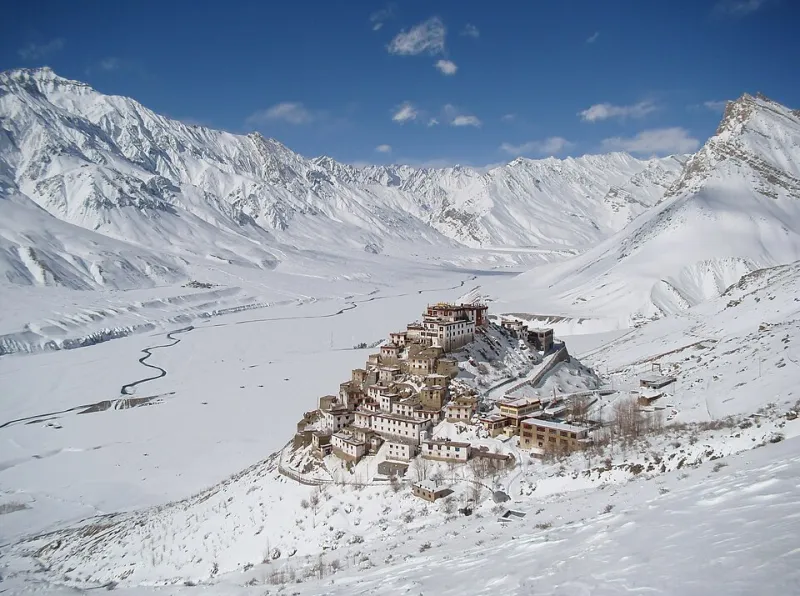
Photo: Original: Kulbhushan Singh Suryawanshi (website) Derivative work: Aristeas, CC BY-SA 4.0, via Wikimedia Commons
Somewhere between your third mindfulness app and your second failed attempt at a 30-day meditation streak, a question probably surfaced: Is this actually working? For a growing number of Americans, the honest answer was no. And that answer led them somewhere unexpected—to the cool, incense-laced halls of a Buddhist monastery in Laos, where the silence isn't curated, the schedule isn't optional, and nobody's tracking your progress with a push notification.
This isn't wellness tourism dressed up in robes. Monastery stays in Laos are the real thing, and they're drawing Americans who are tired of consuming mindfulness as a product.
The Problem with Packaged Peace
The U.S. wellness industry is worth over $1.8 trillion globally, and a sizable chunk of that is built on the promise of inner calm delivered conveniently—through apps, weekend retreats, sound bath sessions, and subscription breathwork programs. There's nothing inherently wrong with any of it. But for people who've cycled through all of it without feeling fundamentally different, there's a growing suspicion that the format itself might be the problem.
Commercial wellness retreats, even the beautiful ones, tend to buffer the experience. There's a schedule crafted for comfort, facilitators trained to keep things emotionally manageable, and a gift shop near the exit. You're guided through difficulty rather than left to sit with it.
Monastic life in Laos doesn't do that. It hands you silence and walks away.
What Monastic Life Actually Looks Like
Most monastery stays for laypeople—non-monks who are welcomed as temporary guests or short-term practitioners—follow a version of the monks' own daily rhythm. That means waking before dawn, sometimes as early as 4:30 a.m., for morning chanting and meditation. Meals happen early and simply, often just twice a day. Afternoons involve work—sweeping courtyards, tending gardens, helping with temple maintenance—or extended periods of unstructured quiet.
There is no agenda beyond the one the monastery has kept for centuries.
What Americans tend to report, often with some surprise, is how confrontational that simplicity feels at first. Without a phone to reach for, without a podcast to fill the gaps, without the comfortable noise of a city or a social feed, the mind does something it rarely gets to do in modern American life: it gets genuinely, uncomfortably bored. And then, if you stay with it long enough, something shifts.
"The first two days I thought I'd made a terrible mistake," said one traveler from Portland who spent nine days at a small monastery outside Luang Prabang. "By day four, I stopped waiting for something to happen. That's when it actually started."
The Mentorship Element Nobody Talks About
One of the most significant differences between a monastery stay and a commercial retreat is access to genuine spiritual guidance—not a certified instructor with a curriculum, but a monk or abbot who has spent decades walking the same path you're just beginning.
In Laos, where Theravada Buddhism is woven into the cultural fabric at every level, many senior monks speak enough English to hold meaningful conversations with Western visitors, particularly in towns like Luang Prabang, Vang Vieng, and Savannakhet that have some history of international contact. These aren't scheduled one-on-ones with a timer running. They're conversations that happen naturally—over tea, after chanting, during a shared meal—and they carry a quality of attention that's hard to find anywhere in the productivity-obsessed West.
The monks aren't trying to fix you or sell you a framework. They're just living their practice, and if you're present enough, you get to learn from watching that.
Finding a Legitimate Monastery Stay
This is where some careful navigation matters. Not every monastery in Laos is set up to host foreign guests, and showing up unannounced at a temple expecting a room is likely to create awkward confusion rather than a meaningful experience.
A few reliable paths in:
Go through established cultural organizations. Groups like the Luang Prabang-based cultural centers that facilitate monk-layperson exchanges often have connections to monasteries open to respectful visitors. The Tourism Information Centre in Luang Prabang is a legitimate starting point for inquiries.
Look for temples with existing programs. Wat Sop Sickharam and a handful of other temples in Luang Prabang have hosted international visitors before and have some informal infrastructure for it. Asking locally—at guesthouses run by Lao families rather than international chains—often surfaces the best leads.
Consider a meditation center as a bridge. Some centers in Laos, affiliated with Buddhist traditions but designed for lay practitioners, offer structured programs that provide a gentler on-ramp to monastic-style practice. These can be a useful first step before seeking a deeper immersion.
Be honest about your intentions. Monasteries that welcome visitors do so as an act of generosity and cultural openness, not as a hospitality service. Coming with genuine curiosity and respect—rather than a content calendar—makes all the difference in how you're received.
What to Expect, Practically Speaking
Accommodations are simple. You're talking a mat or a basic cot, shared facilities, and no climate control in most cases. Laos is hot, particularly from March through May, so timing matters if heat is a concern. The cooler months between November and February are generally more comfortable for extended stays.
Dress modestly—shoulders and knees covered at minimum, and white or neutral clothing is often preferred. Leave the Lululemon at home; it sends the wrong signal. Bring a light blanket, a journal, and more patience than you think you'll need.
Expect to participate in the life of the monastery rather than observe it. That means showing up for chanting even when you don't understand the Pali, sweeping the courtyard without being asked twice, and eating whatever's prepared without commentary. The posture of a good guest here is one of quiet willingness.
Why This Particular Silence Is Different
Laos has a quality that's difficult to articulate but immediately recognizable when you're there—a kind of unhurried depth that feels less like a tourist destination and more like a place that's been quietly itself for a very long time. The monasteries carry that quality in concentrated form.
The silence in a Laotian monastery isn't the absence of sound. There's chanting, birdsong, the sweep of a broom on stone, the distant bells of a temple. It's the absence of urgency. Nothing is asking for your attention. Nothing is optimizing you. The day simply unfolds, and you unfold inside it.
For Americans running on cortisol and calendar notifications, that's not relaxing at first. It's disorienting. And then, slowly, it becomes the most clarifying thing you've ever done.
The meditation apps aren't going anywhere. But if you've been using them long enough to wonder whether there's something they can't give you—there is. And it's about 8,500 miles east, past the Mekong, inside a monastery that's been keeping the same hours since before your great-grandparents were born.