Beyond the Spa: How Laos's Ancient Temples Are Redefining What Wellness Really Means
There's a particular kind of exhaustion that a massage table can't fix. You know the one — the low-grade, chronic kind that builds up over years of back-to-back meetings, doom-scrolling before bed, and the general noise of modern American life. A lot of travelers head to Southeast Asia chasing relief, and many of them find it in Bali's polished retreat centers or Thailand's luxury wellness resorts. But a growing number are pushing further, into quieter territory, and landing somewhere unexpected: the temple towns and forest monasteries of Laos.
What they find there isn't always comfortable. It isn't always Instagram-ready. But nearly every one of them will tell you it's real in a way that's hard to articulate until you've experienced it yourself.
The Difference Between Wellness Tourism and Spiritual Immersion
Let's be honest about what most wellness tourism actually is. You pay a premium for a structured environment — yoga at sunrise, organic meals, guided breathwork, maybe a hot stone massage — and you leave feeling rested. There's nothing wrong with that. But it's fundamentally a consumer experience. You're purchasing relaxation.
What happens inside a Lao Buddhist monastery is something else entirely. It's participatory. It asks something of you. And it operates on a timeline that has nothing to do with your checkout date.
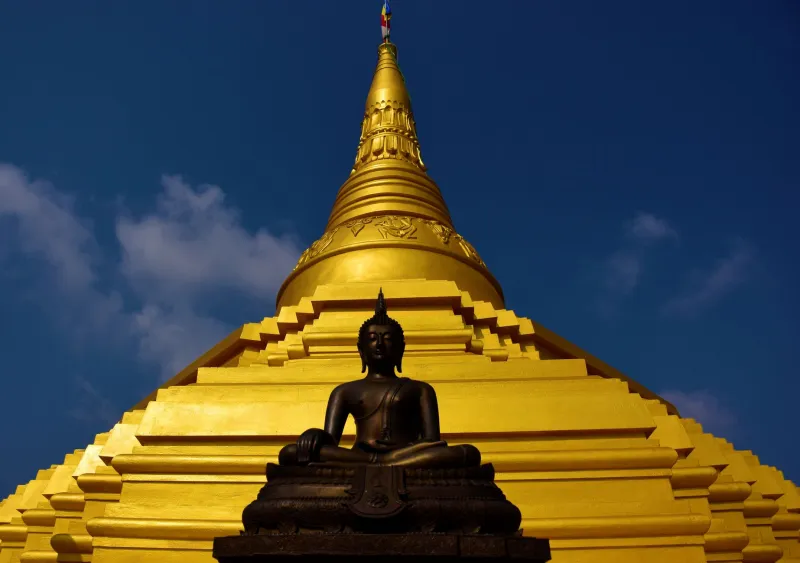
Monasteries throughout Laos — from the UNESCO-listed streets of Luang Prabang to the remote forest temples of Vang Vieng's outskirts and the ancient grounds near Champasak in the south — have long served as community centers for healing, both physical and spiritual. Monks trained in traditional medicine (known locally as mor ya boran) practice herbal treatments passed down through generations. Meditation instruction is offered not as a wellness product but as a fundamental life practice. And healing ceremonies like baci — a ritual blessing involving white strings tied at the wrist to bind wandering spirits back to the body — are conducted with a sincerity that's difficult to fake and impossible to manufacture.
What American Travelers Are Actually Experiencing
Kristin, a 38-year-old occupational therapist from Portland, Oregon, spent two weeks at a small monastery outside Luang Prabang after a difficult divorce. She'd originally planned a standard Southeast Asia backpacker trip but changed course after a conversation with a local guide.
"I ended up staying in a guesthouse right next to the temple grounds," she says. "One of the monks spoke pretty good English and invited me to join the morning meditation sessions. I went once thinking it would be a cultural experience, and I kept going every day for the rest of my trip. It wasn't therapeutic in the way I expected. It was harder than that. But by the end of the second week, something had genuinely shifted."
Her experience isn't unusual. American travelers who engage meaningfully with Laos's temple culture — rather than simply photographing it — frequently describe a similar arc: initial awkwardness, growing stillness, and a quality of presence that's difficult to access back home.
Dave, a 45-year-old high school history teacher from Austin, sought out a traditional Lao massage (nuat boran) at a small healing center attached to a temple in Vientiane. Unlike the tourist-facing massage parlors that line the main streets of most Lao cities, this one operated under the guidance of a monk-trained healer and used techniques informed by both Buddhist energy principles and traditional herbal medicine.
"It wasn't relaxing in the conventional sense," Dave admits, laughing. "It was intense. But two days later I realized my chronic shoulder pain — which I'd had for three years — had basically disappeared. I don't know how to explain that scientifically. I just know it happened."
Finding the Real Thing: A Few Places Worth Knowing
Navigating authentic healing experiences in Laos requires a bit of intention. The country's tourism infrastructure is still relatively modest compared to its neighbors, which is part of what makes it special — but it also means you need to do some homework.
Wat Sop Sickharam, Luang Prabang is one of the lesser-visited temples in a city full of them, and it maintains a small traditional medicine practice open to respectful visitors. The monks here are accustomed to curious foreigners and are generally willing to explain their herbal preparations and answer questions about Buddhist healing philosophy.
The Traditional Arts and Ethnology Centre in Luang Prabang, while technically a museum, serves as an excellent starting point for understanding the indigenous healing traditions of Laos's many ethnic groups — some of which predate Buddhist influence entirely.
Forest monasteries near Pakse, in southern Laos, offer meditation retreats that operate on a dana (donation) model rather than a fixed fee — a meaningful distinction that keeps the experience rooted in spiritual rather than commercial logic. These retreats typically require advance contact through local guesthouses or NGO networks.
How to Approach These Spaces Respectfully
If you're an American traveler used to the frictionless experience of a wellness resort, temple-based healing in Laos will require some adjustment. A few things worth knowing before you go:
Dress matters. Shoulders and knees should be covered when entering any temple space. This isn't a suggestion — it's a baseline condition for being welcomed.
Silence is a language. Many meditation spaces operate in near-total quiet. Resist the urge to fill that silence with questions or observations. Let it do its work.
Don't treat monks like service providers. They are teachers and practitioners operating within a living religious tradition. Approach them with curiosity and humility rather than as vendors of an experience.
Be patient with the pace. Lao temple life moves on its own schedule. The healing, if it comes, arrives on that schedule too — not yours.
Why This Matters More Than Ever
The global wellness industry is now worth over $5 trillion, and a significant chunk of that is being spent by Americans searching for something they can't quite name. What Laos offers — quietly, without much fanfare — is a tradition that has been addressing that unnamed need for centuries.
It isn't about detoxing from your phone or drinking green juice at altitude. It's about encountering a genuinely different relationship with the body, the mind, and the community — one where healing is inseparable from spiritual practice, and spiritual practice is inseparable from daily life.
That's not something you can package neatly. But it is something you can experience, if you're willing to show up for it.
And in Laos, the door is still open.